


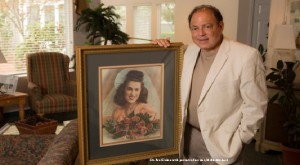
Dr. Paul Colon with portrait of his mother, Millie Michaels
GOVERNOR’S GLEN: Physician’s Mother Inspired the Creation of a Home for Many
link to magazine article: http://www.weareclayton.com/assets/pdf/health2013.pdf
Millie Michaels was a petite woman, less than five feet tall, with a heart that could fill a city bus.
“If she walked into a restaurant by the time she walked out, she would know half of the people there,” said her son Dr. Paul Colon, founder of American Foot & Leg Specialists in Forest Park. ” She was always looking for the best in people.
Millie raised 3 children in a one bedroom, fourth floor walk-up apartment in south Brooklyn after divorcing her first husband. She attained the stereotypical Jewish mother’s most fervent wish: to see her son become a doctor. Actually, both of Millie’s sons became physicians and her daughter became a psychiatric social worker.
She said, “Whatever ever it takes, we’ll get you an education.” I had to work three jobs to help support the family because at (age) thirteen I was the man of the family. But I don’t look at it as a negative. It made me the person I am” clarified Dr. Colon. ” She inspired me to pursue my dreams.”
Her second husband succumbed to pancreatic cancer: But Millie did not want him to die in a hospital, so she cared for him herself at home.
“She was very devoted to him. She was his attendant” said Dr. Colon. “But it took a tremendous toll on her. I saw a profound change in her when he was dying. She became forgetful.”
Dr. Colon moved his mother from New York to Atlanta after her husband passed away. Here, she lived with his family in a nice suburban neighborhood filled with green lawns and cul-de-sacs. Millie relished the clean outdoors and loved to take the family dog out for a walk. A couple of times, however, she would go out and then forget how to find her way back home. “She couldn’t find her wallet or her glasses. Then, she couldn’t recognize family members,” Dr. Colon recalled.
The culprit, of course, was Alzheimer’s disease, diagnosed for Millie in 1991. Although trained as a podiatrist and leading a thriving practice, Dr. Colon threw himself into the study of Alzheimer’s. He started visiting memory impaired assisted living facilities around the country, eventually touring some 100 sites. The first thing he would ask them was, If you had to do anything different, what would it be? “I wanted to learn from what they had not done rather than what they had done,” he said.
He found that Alzheimer’s has no cure—no miracle pill that restores a person’s brain to its youthful vigor. But, he discovered that by keeping a person stimulated and socialized and enhancing their diets with foods rich in antioxidants, like blueberries and tomatoes, the disease’s progression could be delayed. Dr. Colon also found that natural light was very important to the brain’s functions.
Millie, who was in her late seventies, was in the twenty-fifth percentile of the population between the ages of 75 and 85 who becomes afflicted with Alzheimer’s. That percentage leaps to 50 percent of the population over the age of 85. About five million Americans have Alzheimer’s disease.
“Ninety percent of Alzheimer’s is due to aging, with the additional 10 percent due to a defective gene,” said Dr. Colon.
The family got a caregiver to come into the home for Millie, but Dr. Colon noted that she was getting worse. Millie had made her son promise to never put her in a nursing home, but she had hip surgery and needed rehab. Dr.Colon was convinced that his mother was in dire need of a place where she would be around other people. However, on a tour of the Mount Vernon Towers Home in Sandy Springs, Millie pulled her son aside. “There’s nothing but old people here,” she said.
When Dr. Colon finally put her in a rehab center, he told himself it was only temporary. It was a 240-bed facility where his mother was just another old person.“I told myself that there has to be something better out there. I decided that if I couldn’t find a place, I’d build it.”
The result is Governor’s Glen, a memory impaired assisted living home built on seven acres close to Dr. Colon’s podiatric practice. The doctor put together a team of engineers, architects, and bankers to plan and build the home. For Dr. Colon, there was only one criteria: it should be a place his mother would be proud of. “I didn’t want it to be an institution. I wanted it to be a home-like environment, not a jail,” he explained.
Walking up the driveway to tour Governor’s Glen with his visitor, Dr. Colon paused and said, “You’ll notice the driveway is curved. We did this to save these two 100-year old trees.” The front of Governor’s Glen looks like a home with an inviting front porch brimming with rocking chairs overlooking a running fountain with fish, a gazebo, and a short walking trail. Passing through the front door, you head down a short hallway where a hand-painted portrait of Millie hangs over a mantelpiece. From here, there are two hallways, the only ones in the place so as not to confuse the residents, which lead off into opposite directions. The hallway to the right opens onto two pods, which are open areas with streams of natural light coming in from large, high windows. The resident rooms are located around the pods, which surround a small kitchen where the residents get their meals specially prepared in a commercial kitchen that gets much of its food from the nearby Forest Park Farmer’s Market. The hallway to the left leads to a mirror image with two additional living pods. In the middle of the four pods is what is termed a “healing garden” where residents can enjoy the fresh air. Several large pots at one end are filled with tomato vines, eggplants, and herbs that are planted and maintained by some of the residents. Two screened-in porches give people shade and relief from flying insects. The white gate requires that a number code be input to open it so that no one can simply walk away.
“This is a not a place where they come to die, this is a place where they come to live,” said Rebecca Fitzgerald, the community relations coordinator at Governor’s Glen.
The home has several unique features. Very early on Dr. Colon got rid of the van that would take residents to doctor visits. “It was so disruptive for residents. Now we bring the doctors and dentists in. It helps them feel better,” he explained.
In his travels around the country, Dr. Colon learned that stimulation is a determining factor in slowing Alzheimer’s progress, so the home has a full-time activity director. “We have a structure to their lives. We have breakfast and then we exercise. We keep them up on current events by reading the newspaper to them everyday, we celebrate birthdays,” said Fitzgerald. Another big activity is music. When Millie was in the home she had lost her ability to talk. Yet one day when Dr. Colon came in to see a group of people sitting around a piano and singing songs, there was his mother, in her wheelchair, singing along with them.
“Music is the eternal wake-up call,” said Dr. Colon. So at Governor’s Glen, you will find music almost always filling the air. Sometimes musical groups perform live, often with residents joining in on their own instruments, and other times they listen to CDs.
Governor’s Glen accepts full-time residents. It also provides adult day care for families who work, allowing them to drop off their loved ones for eight hours a day. They even have respite care for temporary situations, like if the family is going out of town, for example.
Millie never got to see Governor’s Glen. She passed away in 1997 before the home was completed. But, Dr. Colon said it is her legacy. He built it with her in mind to be a place, as the mission statement says, where the one purpose is to improve the quality of life for residents through socialization and stimulation of the body and mind.
The inscription below Millie’s portrait reads, “Dedicated to the memory of Millie Michaels and all those who have endured the challenges of memory impairment.”
Said Dr. Colon, “Just like my mom, I’m an eternal optimist.”