


While many families look forward to the holidays, the stress that accompanies the winter festivities can be overwhelming for a caregiver. By preparing for family get-togethers, you can save yourself a tremendous amount of stress and have fun with your loved ones. Here are a few tips to try this year:
1. Discuss appropriate gifts.
This is a tip that will help you as a caregiver as well as others who want to celebrate with your loved one. You can talk about good gift ideas for people with Alzheimer’s, suggesting items like photo albums full of wonderful memories, nostalgic music and fun bird feeders. You may event want to put this in writing and mail it to guests ahead of time.
2. Involve your loved one.
As a caregiver, you can involve your loved one with Alzheimer’s in the preparations. Your loved one can help with decorating and food preparation tasks. You should still provide opportunities for your loved one to stick to a normal routine when possible, allowing chances to take a break.
3. Keep your expectations realistic.
The holidays are stressful for most families, especially if they are planning celebrations. Understand that there will be good times and bad times. In the same vein, you should focus on setting limits. Do only what you want to do without pandering to the desires of others. You should never feel that you have to do something.
4. Focus on making memories.
Take pictures, make great conversation and have fun. You should be joining the festivities with the rest of your family, enjoying your precious moments with those visiting from outside of Atlanta. It may be tempting to live in the past, but living in the moment is more rewarding.
5. Know which situations to avoid.
You may wish to avoid situations with large crowds, especially if your loved one is intimidated by feeling social. You should also avoid loud music, unfamiliar surroundings and new foods. The holidays may be stressful for him or her too. Stick to fun stories, familiar meals and enjoying each other’s company.
Following this advice, you will find yourself much more relaxed this year. All of us at Governor’s Glen wish you and your family a wonderful holiday season.
Before National Family Caregiver’s Month transitions into the holidays, we wanted to share some final thoughts on the subject of care giving. Many people find that after having raised their children, they now have a new responsibility—their aging parents. Like learning to raise children, caring for aging parents requires a whole set of new skills. You must learn about their nutritional needs and behavioral habits. Some people must deal with parents who have Alzheimer’s or other forms of dementia. It is in these cases that good planning for long-term care becomes very important.
In the past, one spouse might have stayed home to do the caregiving for elders in the family. However, today, in many couples both partners may work to help pay the bills. It may be possible to have your aging parent live with you, utilizing Governor’s Glen Atlanta adult day care services or respite care. These options can allow people to continue working while caring for aging parents.
In-home care has become a popular option for many seniors. A number of Atlanta agencies provide training, background check and supervision of a hired Caregiver to help seniors who wish to “age in place” stay in their own homes. However, if you want a more thorough type of care, Atlanta assisted living services are available at Governor’s Glen. Our residential community offers social interaction and a number of activities to keep seniors sharp and involved. Alzheimer’s and dementia patients may require specialized care. Atlanta memory care facilities such as the Governor’s Glen Memory Care Assisted Living Community can provide the additional help, supervision, and engaging interaction that these seniors need.
If one of your aging parents is having health problems or has been diagnosed with Alzheimer’s or anther dementia condition, you should sit down with them and discuss their needs for care. A frank discussion of finances should be part of this talk. Involving the parent in the decision can help them to adjust to their changing lifestyle and can allow them a sense of control about the future. Research your range of options. If you would like to visit the Governor’s Glen facilities to ensure that they are suitable for the parent’s need or talk to our team of caregivers to find out more about the facility, don’t hesitate to contact our office or schedule a tour. These measures can help you to find the right situation for your aging parent and can calm your fears about having the responsibility for elders that need special care.
Being a family care giver can be a tough, sometimes thankless job especially when taking care of a loved one with Alzheimer’s or dementia. Normal days can be exhausting physically and emotionally, leaving the care giver tired or discouraged.
However, in our blog last week, we pointed out that November is Family Care Giver’s Awareness month. While you can and should follow any of our suggestions on how to thank or honor any care givers that you know, we want to offer different suggestion to help care giver’s today: Adult Day Care at Governor’s Glen. In addition to our long term assisted living services, our well trained staff offers outstanding adult day care. Unlike typical adult daycare programs, at Governor’s Glen, we allow program participants to stay at our facility for any eight hour period during 24 hour day. Rather than only operating during normal work hours, adult participants can stay at our facility whenever is convenient for you the care giver. Every participant will receive three meals a day and two snack as well as have access to their own private room with furniture provided.
If you are a caregiver yourself, adult daycare at Governor’s Glen can give you a break to rest, recharge, or check some things off your to do list. If you know someone who is a family caregiver who needs a break, have them contact us or sign up for a facility tour.
Regardless, we want to honor all family care givers this month and say thank you for all that you do to take care of your loved ones. And if you are a family caregiver or you know someone who is let the staff at Governor’s Glen give you a break through our adult daycare services.
The month of November is known mainly for Thanksgiving, but did you know that this month is also the National Care Giver’s Month? Caregivers are special people who are dedicated to caring for those who need help. They are patient, gentle and amiable people who know how to deal with special cases like Alzheimer’s or dementia. As a result, they most certainly deserve a month of acknowledgement.
In the United States, there are approximately 90 million caretakers who are responsible for looking out for people with illnesses or old age. National Caregiver’s Month actually started out as a week and was first celebrated in 1994 during the week of Thanksgiving. In 1997, President Clinton made the week of Thanksgiving the official week of the caretakers. As time passed, National Caregiver’s Week turned into National Caregiver’s Month.
If you know a caretaker, it’s important to thank them for their service and celebrate this month. One way you can show a caretaker how much they mean is by giving them some time off. Caretaking is tough work and involves long hours and physically demanding work such as lifting and assisting elders with Alzheimer’s. Having some time off is always a benefit, and you can make the time off even more special by giving them a spa gift card or a free massage certificate.
Another way you can show your love to your caretaker is by verbally thanking them. Tell them all the reasons why they are important to you. Make sure you tell them in a sincere tone of voice and don’t be afraid to give your caregiver a hug. You can also take him/her out to a nice dinner where they can enjoy a warm meal. Furthermore, a nice outing is also a great way to show your caretaker that you love and appreciate all the work they do.
If you really want to express your gratitude, you can give the caretaker a present that they’ll truly love. Gift cards are always a good option because then the person will be able to pick out something that tickles their fancy.
At Governor’s Glen Memory Care Assisted Living Community, we know caretakers are special, which is why you must appreciate, love and care for them. This month, don’t be afraid to show the caretaker you know that they are amazing. A simple thank you can go a long way.
 With expectations that the number of people with Alzheimer’s disease, dementia, and other memory disorders will triple by 2050, there is a vast growing need for professional caregivers and assisted living facilities that accommodate memory care patients with their unique needs and requirements. Memory care patients need heightened levels of supervision and personal attention. They also need extra social and sensory stimulation to keep them engaged in community life. Traditional assisted living facilities may not offer the level of care your loved one needs and deserves.
The Atlanta assisted living community, Governor’s Glen, offers adult daycare, short-term respite care, and long-term assisted living for the elderly suffering from Alzheimer’s disease, dementia, or other cognitive impairments. A daycare participant may come for any 8 hour period during the day to allow his or her at-home caregiver to attend to other things, such as work or running errands. Daycare participants receive the same attention and high level of care as the long-term residents and respite care visitors receive. Everyone is encouraged to participate in a variety of social activities like exercise classes and special entertainment events. Pet and music therapy, among other techniques to encourage residents and visitors to engage with the community, are utilized as well. Governor’s Glen even offers an on-site barber shop and beauty salon for everyone to enjoy.
The compassionate and well-trained staff of Governor’s Glen provides a safe, nurturing, and stimulating environment for your loved one with Alzheimer’s, dementia, or memory loss. The unwavering commitment of the licensed nurses, the on call board certified psychiatrist, and all the other helpful staff to encouraging a lively, invigorating, and socially active environment makes Governor’s Glen a leader in Atlanta assisted living for the memory-impaired. The Governor’s Glen staff is trained to help your loved one to focus and remain socially involved and active. Governor’s Glen is not just a place to stay for the elderly with cognitive impairments, it is a patient-centered community geared toward cognitive improvement.
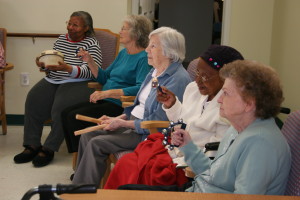
Residents at Governor’s Glen Playing Musical Instruments
When the music is turned on at Governor’s Glen memory impaired assisted living home, the residents begin to react by taping their toes, patting their hands to the rhythm’s beat and many want to get up and dance. Many associate music with important events and a wide array of emotions.
Even those in late stages of dementia and Alzhemier’s receive great benefits from all types of musical activities. This happens because rhythmic and other well-rehearsed responses require little to no cognitive or mental processing. They are influenced by the motor center of the brain that responds directly to auditory rhythmic cues. A person’s ability to engage in music, particularly rhythm playing and singing, remains intact late into the disease process because these activities do not require cognitive functioning for success.
Music has the ability to transport people to a different time and place. Many of the residents at Governor’s Glen, located south of Atlanta, can’t remember their loved ones, but they can remember tunes from their past. Music has also been found to reduce symptoms of anxiety and depression while improving cognitive function.
Music Therapy has been found to be a valuable therapeutic tool for caregivers of people with Alzheimer’s or dementia in promoting interactive communication. It is an activity that residents at Governor’s Glen are exposed to just about every day. They have found it most beneficial in creating interaction among the residents as well as the caretakers.
Ways they encourage people with memory impairment include singing along, clapping hands, dancing, playing musical instruments or just listening to music. The staff at Governor’s Glen have found them all to have enriching benefits.
Governor’s Glen, a beautiful home for those with Alzheimer’s or dementia. Serving residents with families living in and around Atlanta such as Stockbridge, Jonesboro, McDonough, College Park, East Point and others.

Residents love musical activities.
The baby boomers continue to age, and as they do many of their children will become caretakers. Taking Mom or Dad into their home is often just not an option. Assisted Living and Memory Care are two fast-growing options for long-term senior care.
Statistics from the U.S. Department of Health and Human Services show that about 70% of adults over the age of 65 will need long-term care at some point in their lives. When our loved ones can no longer care for themselves, a decision has to be made about their long-term care. It’s a difficult decision because not all long-term care options are created equal.
Assisted living facilities vary in terms of what they offer. Generally speaking, it’s a good place for someone who just needs help with everyday activities like bathing, eating and dressing. It is defined by the Assisted Living Federation of America as “a long-term care option that combines housing, support services and health care, as needed.”
Seniors with complicated medical conditions who require 24-hour nursing care to those who are chronically ill or injured. and need daily care for their personal needs. Some examples of reasons senior might need skilled nursing that a nursing home would offer might be caring for bed bound persons, or on a respirator, or had wounds that were not healing.
This type of home is distinctly different from assisted living or nursing homes. Memory care is a different form of long-term skilled nursing that specifically caters to patients with Alzheimer’s disease, dementia, and other types of memory problems. They provide 24-hour supervised care with staff that are specially trained in to assist people with dementia or impaired cognition.
Governor’s Glen was built and designed specifically to care for dementia and Alzheimer residents. The physical layout and security is better suited for such residents with their wide hallways making it easier to navigate as well as the comfortable and home like surroundings.
 Caring for an adult who suffers from dementia or Alzheimer’s Disease isn’t easy. However, it’s a labor of love that many of us have to face when our parents or loved ones are dealing with a mental impairment. After a while the daily routine can become monotonous, causing depression and other ill effects to set in for all those involved.
Changing up your daily routine a bit can relieve much of the stress and dread associated with doing the same thing day after day after day. In fact, caregivers and their loved ones have a number of options they can consider. Adult day care is one option that provides a number of benefits to those who are living with mental impairments like dementia and Alzheimer’s Disease as well as for their caregivers.
Adult day care is designed to provide care and companionship for seniors or others with mental impairments who need assistance or supervision during the day. It can provide caregivers with a much needed break from their care giving duties. Caregivers can rest easy knowing that their loved one is being cared for in a quality facility by trained staff who have their best interests in mind. Being able to take a break from their care giving duties also allows caregivers to take care of personal business or errands that they may have been putting off in their own lives.
Adult day care also provides the social interaction that so many of those who are living with a mental impairment often lack. It gives them the opportunity to meet people, make new friends and maintain their social skills. This can be very exciting, especially for those who rarely see or visit with anyone aside from their caregiver from day to day.
In addition to the the social aspects, there are a number of activities that attendees can partake in at day care centers as well. These activities are usually designed to strengthen and maintain motor and cognitive skills, both of which tend to deteriorate in the advanced stages of mental impairment.
If you are the caregiver of a person living with a mental impairment, we invite you to learn more about our facility so that you can decide if our program is right for you and your loved one.
Alzheimer’s disease can be one of the most difficult conditions to predict with individuals, patients, or with loved ones. There are some tools that are available for any person who is concerned about their well-being or if a loved one or friend is concerned about the possibility of Alzheimer’s. One of the major tools is a process called memory screening. It is important to keep in mind, however, that memory screening is not a pure diagnostic tool. Instead, it is tool to be used to see if a person might have the signs or symptoms of Alzheimer’s. If you or a loved one is concerned about the result of a memory screening, then please contact a medical professional who can properly diagnose a patient with Alzheimer’s.
Memory screening is a procedure endorsed by the Alzheimer’s Foundation of America. During the month of November, which is National Alzheimer’s Disease Awareness Month, the Alzheimer’s Foundation promote using the memory screening method. The Alzheimer’s Foundation also states that anyone who is beginning to have trouble remembering things, concentrating, forgetting where they are going, or having difficulty performing regular tasks may benefit from taking a memory screening. The American Academy of Neurology recommends that memory screening should be given to individuals who clearly show signs of what many would think is dementia. It is not recommended to provide memory screening for every person. Widespread use of memory screening is not considered effective, and it can lead to many false positives.
Memory screenings are performed by a wide range of professionals, such as social workers, nurse practitioners, and psychologists. The tests are done one-on-one with the individual with the potential symptoms of Alzheimer’s disease. In these sessions, the professional asks a series of questions and tasks to complete for the individual. These may range from language skills, critical thinking skills, and memory tests.
Based upon the results of these tests, which are confidential, the testing administrator may suggest to the person to further seek medical attention. Only a qualified medical professional can actually diagnose the individual with Alzheimer’s disease. Because of this, a participant may still want to seek medical attention if they are concerned. Some cases for individuals may be forms of dementia that do not appear to be Alzheimer’s. Other cases could come up as false positives. Either way, it is important to remember that memory screenings are useful tools to only help individuals or families further seek medical advice if Alzheimer’s is suspected.
For those who suffer from dementia, visitors can add a rich and an enjoyable part of their day. As a visitor, it is important to understand the challenges that your loved one may be experiencing with memory loss. Follow these five tips from Governor’s Glen for making your visit an enjoyable occasion.
1. Consult with Caregivers
Whether the caregiver is a family member or a trained professional, ask them for information that will help make the most pleasant visit possible. People affected by dementia may be upset by loud noises, rattled with too many visitors in their room, or startled by the sudden approach of a person they cannot recognize immediately. Whenever possible, have the caregiver introduce you to ease your transition into the room and maintain the person’s dignity and respect.
2. Assist Them with a Favorite Activity
People affected by dementia are strongly encouraged to continue with the activities that they enjoy. To make a visit especially enjoyable, offer to assist your loved one with letter writing, scrapbooking or walking out by the garden. Ensure that these activities are safe and do not exceed the amount of time that your loved one can endure physically or emotionally tolerate. Often, only a few minutes of pleasurable activities can brighten a person’s mood and make them smile.
3. Understanding Aggression and Anger Outbursts
For those who suffer with memory loss, the part of the brain that “filters” behavior may become less effective and behavioral changes can result. If your loved one suddenly begins to show signs of agitation, they may be experiencing a confusion that causes them intense anxiety and fear. If you should experience this behavior during a visit, stay calm and keep the person safe. Try to refocus their attention to another activity or task, and speak to them in soft and reassuring tones.
4. Find out the Best Time to Visit
People with memory loss are usually the most comfortable when their daily routines remain the same and they know what to expect. Refrain from visiting during mealtime, their personal care schedule or during their favorite TV program. Often, your loved one may be more alert and receptive to your company in the early part of the day.
5. Be Respectful and do not Argue
People with memory problems often do not remember names or events. Do not attempt to correct them or help them to tell the story. By challenging their memory, you may escalate their confusion and worsen their anxiety.
Visiting a person with memory challenges can be a pleasant experience that enriches the life of your loved one. With simple tips and a little extra effort, you can enjoy the company of the ones you love.